EN
 FR



› Blog/travel
October 2022 |
Hildesheim, a UNESCO Town
The town of Hildesheim, in Lower Saxony, in central Germany, has several buildings inscribed on the UNESCO World Heritage List.
Near Hanover, the town was the heart of the Ottonian imperial dynasty in the 10th and 11th centuries.
It still has architectural witnesses of this period, despite almost total destruction during the Second World War. Its historic centre and many buildings were rebuilt identically after the bombings.
Here is what not to miss during your stay in Hildesheim:
- St. Mary’s Cathedral
- St. Michael’s Church
- The historic town centre
St. Mary’s Cathedral in Hildesheim
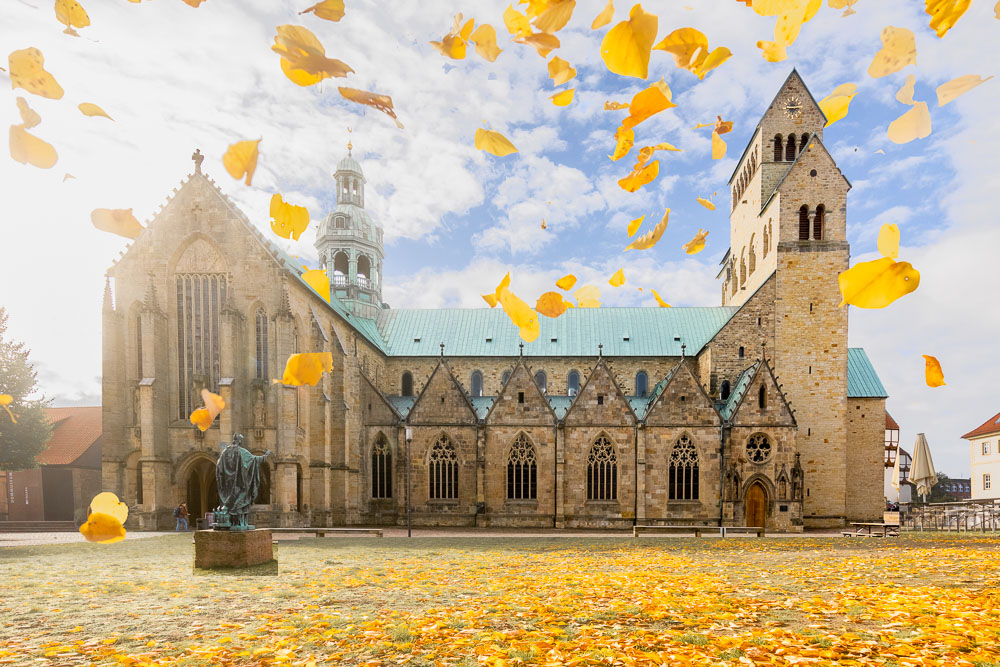
Hildesheim’s St. Mary’s Cathedral is a jewel of Romanesque art. Listed by UNESCO, it bears the marks of history. Built from 872 and enlarged from the 11th to the 14th century, it was largely destroyed by shellfire in 1945. Rebuilt in the 1950s, the cathedral lost its Romanesque and Baroque decoration for a simpler style.
Its treasury, also listed by UNESCO, keeps some witnesses of its former splendour. In the cathedral’s westwork stands the Bernward Door: two bronze leaves depicting Genesis, made in 1015 for the town’s bishop, the future Saint Bernward. Five years later, he also commissioned the Christ Column, inspired by Trajan’s Column, still kept in the cathedral.
While visiting the cathedral’s courtyards, I admired the thousand-year-old rosebush growing along the apse wall of St. Mary’s Cathedral. A symbol of the town, it survived the bombings of the Second World War. Every May, its flowers still bring colour to the cloister.


St. Michael’s Church in Hildesheim
Not far from the cathedral, St. Michael’s Church is also inscribed on the UNESCO World Heritage List. Built within a Benedictine abbey in the 11th century, it too was commissioned by Bishop Bernward, who is buried there. Originally Catholic, it later became a Protestant church.
Although its style is sober, just look up to discover the magnificent nave ceiling. Made of wood and entirely painted, this work more than 27 metres long and 8 metres wide depicts the Tree of Jesse. It was made at the end of the 12th century to celebrate Bernward’s canonisation.
It is one of only two surviving examples of such a structure, the other being in Switzerland.
First Catholic, St. Michael’s Church became Protestant in the 16th century with Luther’s Reformation. It was even briefly secularised when Napoleon passed through the Holy Roman Empire.
St. Michael’s Church also suffered the bombings and fires of 1945. Rebuilt at the same time as St. Mary’s Cathedral, it returned to a dual use: Lutheran in the church and Catholic in the crypt!


Hildesheim’s historic centre, scarred by war
Although 40% of it was destroyed during the Second World War, Hildesheim has kept much of its original charm. The Marktplatz, at the heart of the historic centre, is one of the most beautiful squares I’ve seen in Germany. Devastated by the Allies in March 1945, it was rebuilt identically between 1984 and 1989.
Here you find all the houses of the food trade guilds. The Butchers’ Guild Hall is the most imposing. Built in 1529 and rebuilt with the square, this half-timbered house is a magnificent example of the German Renaissance style. A unique architectural style that the sunshine allowed me to capture.

Photo Tips
Best times to take photos:
- Favour morning and evening for the best light
Photo spots:
- The ceiling of St. Michael’s Church
- The cloister of St. Mary’s Cathedral
Photo gear to bring:
- Wide-angle lens
- Tripod
- Use what’s on site: shop windows for reflections
See all