EN
 FR




› Blog/travel
November 2020 |
The road Napoleon in Citroën 2CV
The road Napoleon: introduction
This article retraces our epic trip along the Route Napoléon, in Provence-Alpes-Côte d’Azur, in July 2020. I travelled with my teammate Romain Paillette, at the wheel of a legendary orange Citroën 2CV named Clementine!
The Road Napoleon, whose first routes date back to the end of the 18th century, became famous thanks to Napoléon Bonaparte.
In fact, after escaping from Elba to win back power (the Hundred Days), the Emperor landed at Golfe-Juan with 1,200 men. From there, he marched to Grenoble.
Presentation of the itinerary
The Route Napoléon therefore links Golfe-Juan to Grenoble. We drove the whole route in our 2CV; however, this article mainly covers the stretch from Golfe-Juan to Gap. Here are the stages:
- Golfe-Juan: landing of Napoleon on March 1st 1815
- Grasse: Napoleon’s stay on March 2, 1815
- La Martre: Napoleon’s stopover March 3, 1815
- Castellane: Napoleon’s stay on March 3, 1815
- Digne-les-Bains: Napoleon’s stay on March 4, 1815
- Sisteron: Napoleon’s strategic passage on March 5, 1815.
- Gap: Napoleon’s arrival on March 5, 1815
The itinerary is shown on the map below:

Today, the N85, known as the “Route Napoléon”, hardly follows the Emperor’s exact path anymore. Even so, it remains an extraordinary road with majestic landscapes.
It is also a road full of history and legends thanks to its towns, monuments, statues and plaques that recall the lightning passage of General Bonaparte.
First step: Golfe-Juan
Golfe-Juan is a seaside resort on the French Riviera, part of the town of Vallauris.
- Napoleon landed in Golfe-Juan from the Island of Elba on March 1, 1815.
- This is where our adventure on the Route Napoleon begins, on July 12, 2020.

First of all, when we go to Golfe-Juan, we discover a typical seaside resort of the French Riviera, with its marina, seaside restaurants and bathers.
Golfe-Juan, the beach where Napoleon landed on March 1, 1815
Come early in the morning, when the beach is still empty! At the water’s edge, lulled by the waves, close your eyes. Then imagine boats appearing in the distance, with Napoleon on board! If your imagination goes that far, you may even see him land… and who knows, perhaps greet him!


Let’s get out of our daydreams and go now to the marina. Let’s go to the Avenue des Frères Roustan, for a coffee at l’Escale. It is here, opposite, that there is a mosaic with an Eagle and an inscription:
“Here landed Napoleon, 1815”.


Beginning of the Napoleon Route
In our back, the rue de la Gare with a sign indicates :
“Here the Route Napoleon begins”.
For us, the adventure begins here! Our 2CV Clementine is parked where two legendary roads meet: the N7 and the N85. Behind it stand Art Deco houses, typical of Golfe-Juan.
At the crossing, a column pays homage to the Emperor:
“Hello France, Land of the Brave! “can be read at the foot of the monument under the bust of Bonaparte. Bonaparte sits proudly at the top of the monument, staring at the marching cars like his troops.
Hello Golfe-Juan, on the way to Grasse!
Second step : Grasse
Grasse is a town on the French Riviera, perched at about 400 metres. Since the 17th century, it has been considered the world capital of perfume.
- Napoleon entered Grasse with his troops on March 2, 1815.
- We stopped in Grasse from July 12 to 13, 2020.

The World Capital of Perfumes
As we climb towards Grasse, the first scents from the perfume factories and shops reach us. In fact, these fruity fragrances even mask the smell of hot oil from our old 2CV’s boiling engine.
Indeed, in Grasse the great houses of perfumers Fragonard, Galimard, Molinard have been making the city famous for several centuries.
Under the pink umbrellas that decorate and protect from the burning sun, the city offers a feeling of slowness and a sweetness of life. Thus, Grasse is the ideal place for a regiment having made a long march.


Napoleon stopped here on 2 March 1815 to have lunch with his generals. According to tradition, he left behind four cannons and several carriages, probably to reach Grenoble faster. In fact, he and his men reached the city in just a few days.
On the Grande Place, a plaque honours him. In addition, the Espace Napoléon displays a surprising collection of 400 objects about the Emperor, donated by the collector Robert Bartolozzi.


After having impregnated us with the perfume of the city we leave behind us this city with the warm colors. The Marten awaits us!
Third step: La Martre
La Martre (211 inhabitants) commune of the Var located at about 1000 meters of altitude.
- Napoleon made a stopover on March 3, 1815 at the Logis du Pin inn.
- We stayed in La Martre from July 13th to July 14th.

We continue our journey in the footsteps of the Emperor.
As we advance, the road starts to become more winding and steep. But this is nothing compared to what awaits us between Gap and Grenoble. Indeed, the landscapes become more and more mountainous.
Deep in the Artuby gorges, we reach the small village of La Martre. Its name comes from the marten, “la Martro” in Provençal.


The Logis du Pin
Here, on 3 March 1815, Napoleon and his men stopped for lunch at the Logis du Pin. We also parked our 2CV here to walk through the village and look for traces of that time.


We take small paths lost in the shade of the pines, we cross vast meadows where we can see horses galloping in the distance.
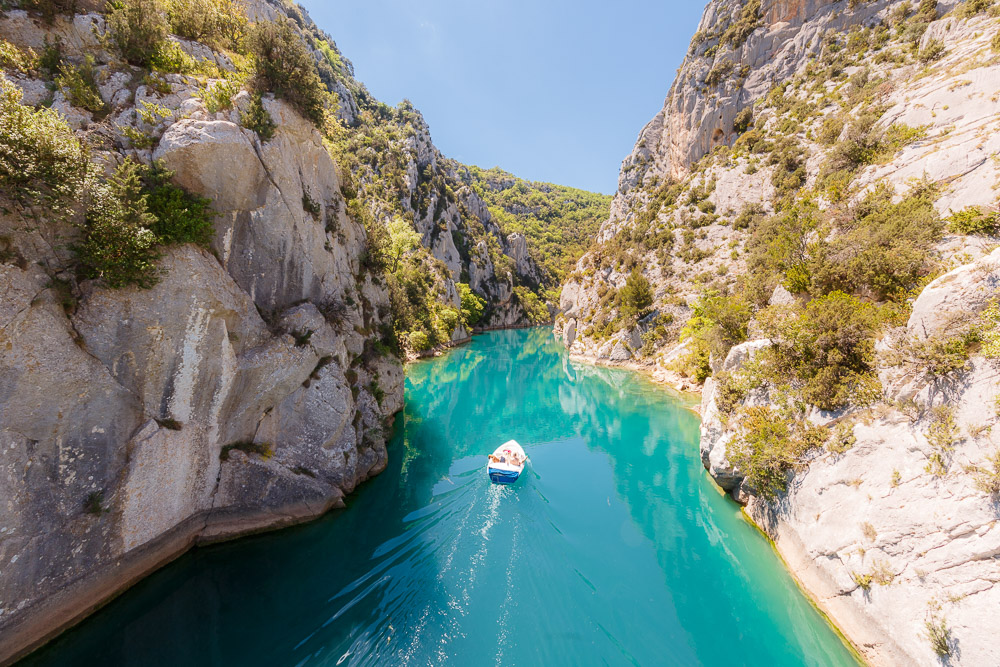
We follow the banks of a turquoise blue river. Finally we pass by the bridge of Madame, a small stone arch dating from the 18th century. Did they pass by here more than 200 years ago? The day begins to fall and still no trace of any passage of the “Enlightened Despot”.
As we climb a small path towards La Martre, we come face to face with the famous bust of Napoleon. Jules Chaperon erected it in the early 20th century!
“This old path leads to the Logis du Pin (4 kilos) where the Emperor Napoleon I stopped for lunch on March 3, 1815” we read below.
This is where we are also going and this is where we will leave from!
“Victory in song opens the barrier for us… “
To us Castellane!
Fourth step: Castellane
Castellane (1 524 inhabitants) is a commune of the Alpes de Haute Provence located at 722 meters altitude, gateway to the Gorges du Verdon.
- Napoleon went there on March 3, 1815 to spend the night.
- We stayed in Castellane on the night of July 14, being able to enjoy the fireworks, one of the most important in the region.
You can also see my article on the Gorges du Verdon

Only 17 km separate Castellane from the Martre.
At the end of 3 March 1815, Napoleon arrives in this small town at the foot of the Roc, beside the Verdon. Here, the smallest sub-prefecture in France welcomes him.
At the top of the famous rock overhanging the city, Notre-Dame du Roc stands as a protector on the chapel of the same name. Did the Emperor ask for her blessing? Still, his mission to reach Grenoble will come to a successful conclusion.
The Gateway to the Gorges du Verdon


For our part it is the 14th of July, National Day that we arrive. Before enjoying the fireworks we decide to deviate a little from the Napoleon Road. We then take the road of the peaks to admire the Gorges du Verdon.
It is quite simply the largest Canyon of Europe!
These vast, sumptuous landscapes invite daydreaming, and we feel alone before such immensity. In the distance, vultures circle up towards the sun.


National Day in Castellane
As night falls, we end our walk at the foot of the old pentagonal tower. Then we watch the fireworks light up the town, the Roc and the Virgin for Bastille Day.


Fifth step: Digne-les-Bains
Digne-les-Bains (16 460 inhabitants) is a spa resort in the Alpes de Haute Provence. It is the prefecture of the Alpes de Haute Provence department.
- Napoleon went to Digne-les-Bains on March 4, 1815.
- We were there on July 16, 2020
You can also see my article on Digne-les-Bains and the Durance Valley.


The Napoleon Road, from Castellane to Digne, is not lacking in anecdotes.
It is 4 March 1815. The troop left very early, and the Emperor has not eaten yet. So, while waiting for a proper lunch in Digne, he stops at an inn in the hamlet of La Clappe for an omelette:
“A luxury omelette! “Indeed, the note seemed “a hair” salty to our conqueror! “Eggs are so rare here,” he asked astonished. “No, not eggs, but emperors, yes,” replied the mischievous innkeeper.
A Napoleon careful with his money? We can understand him! Moreover, as he left the inn, one of his mules carrying gold reportedly fell into a ravine. According to legend, soldiers and villagers rushed to gather the coins, and some may still lie there.
The Emperor finally reached Digne at noon and stayed three hours, long enough to eat at the Hôtel du Petit Paris. Today, a plaque still marks the spot.
The advance towards Digne-les-Bains!
Let’s continue along the Route Napoléon to Digne-les-Bains, beside the Bléone. Here, the scenery offers a wonderful range of colours. The river’s turquoise water blends with lavender fields and mountains of black and red-orange rock.


Malijai
The road is still long and serious things are about to begin. Sisteron the Royalist citadel city stands in the distance.
This next stage is likely to be eventful. Indeed, the city is far from being acquired to the cause. But the night brings advice, it is said. The castle of Malijai will be the ideal place to welcome the infantrymen and the most victorious of the Generals.
The sun sets behind the Penitents of the Mées. A large fire warms the Grenadiers who bivouac in the courtyard. Upstairs, Napoleon falls asleep on the aloud readings of the Fables de la Fontaine read by General Bertrand.

Sixth step: Sisteron
Sisteron (7 460 inhabitants) is a town in the Alpes-de-Haute-Provence known for its medieval citadel overlooking the town.
- Napoleon passed through it on March 5, 1815.
- Clementine the Citroën 2CV crossed Sisteron on July 17, 2020

Crossing the Durance, we feel tiny before the Rocher de la Baume. Behind us, 500 metres up, stands the imposing medieval citadel of Sisteron, later remodelled by Vauban.
Sisteron worried the Emperor a lot. First of all, the city was famous for its rock and its fortress, a real rampart against the invaders. Moreover, its population was acquired by the King.


5 March 1815, 2 a.m. The Emperor finally relaxes when a rider returns from Sisteron. In fact, the town has submitted and all resistance has ended.
Around 10 a.m., Sisteron opens its gates to the Emperor: “Soldiers, we are saved, we are in Paris!” He then enters the town and stops for a meal at the Hôtel du Bras d’Or, rue Saunerie (there is a plaque).
But soon the population began to resemble each other and became nervous. Napoleon hurriedly left Sisteron, barely three hours after entering.
Sisteron crossed, direction Grenoble distance of some 150 kms, the reconquest is not very far!


Seventh step: Gap
Gap (40,895 inhabitants) Gap is a commune in the Hautes-Alpes whose highest point reaches 2361 meters.
- Napoleon arrived in Gap on March 5, 1815.
- We stayed there on July 17, 2020

Tallard and its Castle of the XIVth century
On the road towards Gap we decide to make a slight detour on the D46 to admire Tallard and its medieval castle of the 14th century.
From the road, the view is sublime. In the distance, the castle stands before La Rochette, a 1,421-metre mountain. Because of its shape, locals call it “le Chapeau de Napoléon”, after his bicorne hat.
Let’s go to Gap!
Then we return to the N85. A few kilometres from Gap, an eagle on its pedestal proudly shows us the way. On the beach at Golfe-Juan, on 1 March 1815, Napoleon had written to the army:
“The Eagle with the national colors will fly from bell tower to bell tower to the towers of Notre-Dame. »


Napoleon’s arrival in Gap
The impressive procession entered Gap south of the city through the Dove Gate on March 5, 1815.
Unlike Sisteron, the Emperor was welcomed as savior and hero by the people of Gap. Everyone or almost everyone! The mayor of the city, the Marquis Jean-François d’Abon, was not pleased with the arrival of Napoleone Buonaparte.
When the latter asked him :
“What do you think of my return Marquis? “
The answer was scathing:
“I think he’s unhappy for France, as he is for you…”
Napoleon already felt he was on conquered ground. The royal army was deployed everywhere; however, it was always one step behind.
“I’ve been quiet since the hour I set foot in the Hautes-Alpes. »
Napoleon’s Night at Gap
Napoleon dined and spent the night in the only comfortable place in town, the Auberge Marchand. This house, once the inn of the Marchand couple, still stands at 17 rue de France. Moreover, a beautiful fresco was painted there in 1997.


On leaving the city, here is what Napoleon wrote to the Gapençais to thank them for their welcome:
“Citizens, I was deeply touched by all the feelings you have shown me. Your wishes will be granted. The cause of the Nation will triumph again. You are right to call me your father; I live only for the honor and happiness of France. (…) In all the circumstances in which I may find myself, I will always remember with great interest all that I have seen while crossing your country. »
There was one last step left in Grenoble for Paris and France to be conquered again!
Last step : Laffrey before Grenoble
Laffrey (429 inhabitants) is a village in Isère near Grenoble known for the episode of “La Prairie de la Rencontre”.

The Napoleon Road becomes resolutely mountainous from Gap to Grenoble
For Clementine, our Citroën 2CV, the road between Gap and Grenoble was probably the most difficult:
Indeed, the slopes are steep, and we sometimes climb them at under 25 km/h, with a line of cars behind us!
The descents are not easy either, and they test the clutch and brakes.
Back to 6 March 1815: the small army leaves Gap. It spends the night in Corps, then reaches La Mure before heading for Grenoble.
The Meadow of Encounter
On 7 March 1815, the Emperor is only a few kilometres from his goal. He reaches the village of Laffrey. However, on the plain later nicknamed “La Prairie de la Rencontre”, a battalion of the 5th Line Regiment, sent by Louis XVIII, awaits him.
Fate was going to play itself out here
It was then that Napoleon moved away from Cambronne and its soldiers. He approached the soldiers of the regular army. They had undoubtedly fought at his side during his war epics in Europe.
A silence fell, then the Emperor of all the French pronounced these words that will remain forever engraved in History.
“Soldiers, I am your Emperor, don’t you recognize me? »
These words of Napoleon, pronounced with such aplomb, could not leave anyone who had fought at Wagram, Jena or Austerlitz indifferent.
The denouement
The emotion was felt, Napoleon approached again within shooting range this time and unbuttoned his frock and let his chest appear:
“If there is one among you who wants to kill his General, here I am!”
To this resounding sentence, King Louis XVIII’s battalion laid down its arms one by one.
Overcome, some soldiers fall to their knees in tears, while others run towards him crying “Long live the Emperor!”. Napoleon then turns to Cambronne and declares:
“It is finished. In eight days we will be in Paris. »
End of our adventure and last stage before Grenoble
Our Napoleonic adventure ends here, at the foot of the equestrian statue by Emmanuel Frémiet, erected in 1868 under Napoleon III. Facing the mountains and Lake Laffrey, Napoleon still sits proudly on his horse, his gaze fixed on the future. Even today, this legend makes him a myth.
3000km in a Citroën 2CV
For us the adventure also ends. After Grenoble we return by the Nationale 6 and Burgundy. Our old 2cv Clementine is a little tired after 3000 km, however no mechanical problems are to be reported.
We start dreaming about our future trips and conquests and we say to ourselves that “Impossible is not French”.
See all