EN
 FR





› Blog/travel
November 2023 |
The ShUM Sites of Mainz, Speyer and Worms
Let me take you to discover the ShUM sites, the origins of Ashkenazi culture, in the German cities of Mainz, Speyer and Worms.
Ashkenazi Jewish tradition and its language, Yiddish, were born in these cities along the Rhine valley more than a thousand years ago.
Today, Mainz, Speyer and Worms preserve a thousand-year-old Jewish heritage, inscribed on the UNESCO World Heritage List since 2021.
Mainz and Worms: the oldest Jewish cemeteries in Europe
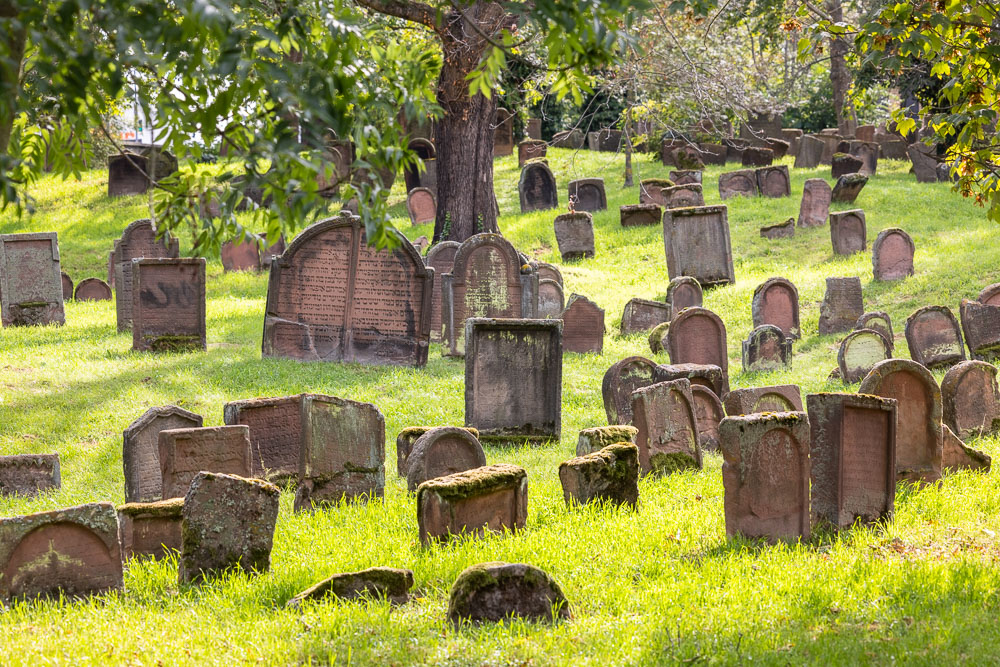
Mainz and Worms have the oldest Jewish cemeteries in Europe: they are more than a thousand years old!
The Jewish cemetery of Mainz:
In Mainz, this Jewish cemetery still has more than 200 graves. The site is very rarely open to the public, and only on closely supervised guided tours. I was able to visit freely thanks to my Ashkenazi Jewish roots.


The Jewish cemetery of Worms:
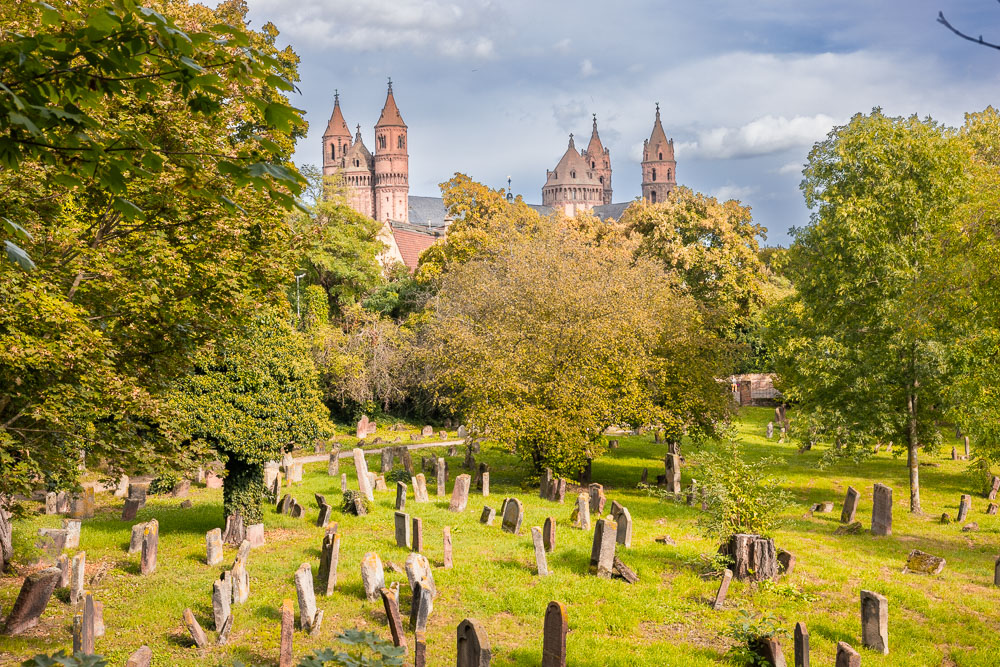
The Worms cemetery is also considered the largest Ashkenazi Jewish cemetery in Europe. Its oldest grave dates from 1035!
To this day, the cemetery remains a place of pilgrimage for the Ashkenazi Jewish community: illustrious rabbis are buried here.
When visiting these cemeteries, men must remember to cover their heads. A kippah is best, but any other headwear will do…
As I hadn’t been warned, my guide saved the day by lending me the detachable hood of her windbreaker!
The Ashkenazi Jewish heritage of the ShUM sites:
Jewish heritage in Speyer:
Speyer has the oldest and best-preserved Jewish ritual bath, or mikveh, in Central Europe.
It was built in the 12th century in the heart of the medieval town’s Judenhof (Jewish courtyard), at the same time as the synagogue, of which only the east wall remains. The architect and workers on these buildings also worked on Speyer Cathedral.
Speyer’s mikveh, 10 metres underground, is still fed by underground springs today.
Jewish heritage in Worms:
Worms has the oldest synagogue in Germany, founded in 1034!
Damaged during the Crusades, it was rebuilt in the Romanesque style at the end of the 12th century. Destroyed during the Nazi era and the Second World War, it was rebuilt identically.


Next to the synagogue stands the Rashi House, named after the famous Jewish scholar from Troyes (France), who studied here around 1060. Today only the building’s medieval vaulted cellars remain, turned into a museum that highlights Ashkenazi Jewish culture and also gathers testimonies from the Nazi period.

Remembering the persecution of the Jews
Places of remembrance in Speyer:
In Speyer, a sculpture commemorates the Jewish community persecuted in the Middle Ages. Blamed among other things for plague epidemics, the Jews of Speyer (and of Germany more widely) suffered many pogroms throughout history. This German Ashkenazi community was finally wiped out by the Holocaust.
Today, Speyer is a city of reconciliation: former German chancellor Helmut Kohl liked to receive foreign leaders here, including President Mitterrand. Kohl is buried here.
Remembrance in Worms:
In Worms, the Holocaust is remembered in the streets: some paving stones have been replaced by commemorative plaques giving the names of residents who were arrested and deported, with the place and date of their deportation.
Much more contemporary, the New Synagogue of Mainz embodies the revival of Ashkenazi Jewish culture in Germany.


The cathedrals of the ShUM cities
Speyer has the largest Romanesque church in the world! An imperial cathedral, it was founded by Conrad II in 1030 and rebuilt by Henry IV in 1077. The burial place of the Holy Roman Emperors for 300 years, it holds the tombs of eight of them… It is also inscribed on the UNESCO World Heritage List.
At weekends, the main street leading to the cathedral hosts the market: a convivial moment not to be missed.
Worms Cathedral is also superb: I was very lucky to see it crowned by a double rainbow at sunset. Be careful, though: flying a drone with rain or storms nearby is very risky!
In the heart of Mainz, St. Martin’s Cathedral is also worth the detour, with the emblematic red stone that has coloured the city centre for more than 1,000 years!


Photo tips:
- Visit the Jewish cemeteries in autumn: the golden light gives these places of remembrance a special atmosphere.
- Like most churches, Speyer Cathedral is oriented east-west, so its façade and chevet are lit at sunset and sunrise, letting you enjoy those warm colours.
- In Mainz, don’t even think about getting the drone out: Frankfurt airport is too close!
See all my reports on the German sites inscribed on the UNESCO World Heritage List.
See all