EN
 FR




› Blog/travel
November 2023 |
In the Footsteps of Lucien Mazan Petit-Breton
Let me take you to Loire-Atlantique for a very personal story. Let’s go back 120 years, in the footsteps of Lucien Mazan Petit-Breton, my great-grandfather.
The first double winner of the Tour de France, in 1907 and 1908, he was also a pioneer of photography!
My great-grandfather travelled all over southern Brittany, especially today’s Loire-Atlantique. In the early 20th century, he took many photos of the region.
The glass plates stayed in the family, and we restored them to reprint some of his pictures. They show life in the Belle Époque, and then the First World War that cut it short.
I inherited his passion for photography (less so for cycling!). So, camera in hand, I set out to find the places in his photos and reproduce them. The goal: a before-and-after, 120 years later!

- Plessé, near Redon, in Loire-Atlantique: his birthplace
- Vallet, near Clisson, in Loire-Atlantique: where he got married
- Pénestin, near Guérande, in Morbihan: where he lived and is buried
Plessé in Loire-Atlantique: my great-grandfather’s birthplace, near Redon

Lucien Mazan Petit-Breton’s birth in Plessé
My great-grandfather was born in Plessé, south of Redon, in 1882, a century before me. A commemorative plaque marks the house where he was born. Today, the town of 5,000 inhabitants pays tribute to him by naming its municipal sports complex after Lucien Petit-Breton!

Before / After at the Rocher du Veau
A few kilometres away, he had taken a bucolic photo at the Rocher du Veau, above the river Don. Surprise: nature has taken over and the landscape has changed a lot. You can hardly see the water, and the bridge has gone!
I went in summer, whereas his photo dates from winter, perhaps during the 1910 flood. That partly explains the difference. Still, this before-and-after shows that nature is lusher today!


Before / After at the Château du Brossay in Renac
The second before-and-after is at the Château du Brossay in Renac, a beautiful castle built at the very beginning of the 20th century.
My great-grandfather had posed with his bike in front of the castle and its pond. Today, plants cover part of the water, so I could not recreate the mirror effect. However, I found a canine friend to liven up the photo!


Redon in Ille-et-Vilaine
Next, I stopped in Redon, where the Vilaine meets the Oust. The town grew thanks to the canalisation of the Vilaine and then the Nantes–Brest canal. As a result, Redon became the outer port of Rennes.
The port became the beating heart of the town, buzzing with trade, as my great-grandfather’s photos show. I was able to reproduce several of them, but activity seems to have calmed down a lot.


Apparently, my great-grandfather never thought of photographing the houses reflected in the Vilaine. I couldn’t resist: it’s my signature!
Find out more about the Nantes–Brest canal through Redon.


Vallet: where my great-grandparents married, near Clisson
A wedding in Vallet
The second stage of my journey takes me to Vallet, in the heart of the Nantes vineyards, near Maine-et-Loire. It is my great-grandmother’s hometown, and she married my great-grandfather there.
They were married on 24 November 1908 in Vallet church. I wanted to reproduce a photo taken that day in front of the church. The church door hasn’t changed!
Before / After in the Nantes vineyards
The Nantes vineyards are, as the name suggests, right on the doorstep of Nantes!
This is where a very particular white wine is produced: Muscadet. For the centenary of my great-grandfather’s first Tour de France victory, a special Lucien Petit-Breton cuvée was created!


My great-grandfather had captured fields flooded during the great flood of 1910.
I was able to photograph the same landscape, dry this time. Early vegetables now grow there.


Clisson, the pearl of Loire-Atlantique
A must in the Nantes vineyards, I stopped in Clisson to take a few shots. This heritage gem of Loire-Atlantique stands on the banks of the Sèvre Nantaise, facing the Vendée. The town and its medieval castle change appearance with every hour of the day and every season.
I’m actually surprised he took no photos in this town. Perhaps they were lost… Or perhaps people cared little about heritage back then.

This town of the Marches of Brittany has a very rich history. It was the keystone of the region’s defensive system against Poitou and Anjou. Francis II, Duke of Brittany and father of Anne of Brittany, was born in this fortress.
Today, Clisson is nicknamed the French Tivoli. This Italian atmosphere comes from the Neoclassical artist François-Frédéric Lemot. He fell in love with the place in the early 19th century and created a poetic landscape inspired by Italy.
Since 2006, the mood has been much louder every summer. For four days, Clisson hosts France’s biggest metal festival: Hellfest.
More information on Clisson, an Italian-style town!
Pénestin: my great-grandfather’s resting place, near Guérande

Pénestin, the family home and Lucien Mazan Petit-Breton’s final resting place
The last stage in my great-grandfather’s footsteps is Pénestin, at the tip of the Guérande peninsula. In 1915, he bought a house there that still belongs to my family.
He was killed at the front in 1917 and had little time to enjoy this haven. Even so, he lies in the village cemetery, in the Breton land he loved so much.


Before / After from the family home
From his bedroom window, I took the last photo of my series. It shows the gate leading to the cliff, with a sweeping view of the ocean and the Mine d’Or cliffs.
However, trees now change the composition. My grandfather planted them to hold the cliff together and protect this unique landscape!


The Mine d’Or of Pénestin
Pénestin lies at the tip of the Guérande peninsula, on the Vilaine estuary. Yet it belongs to Morbihan, while the rest of the peninsula is in Loire-Atlantique.
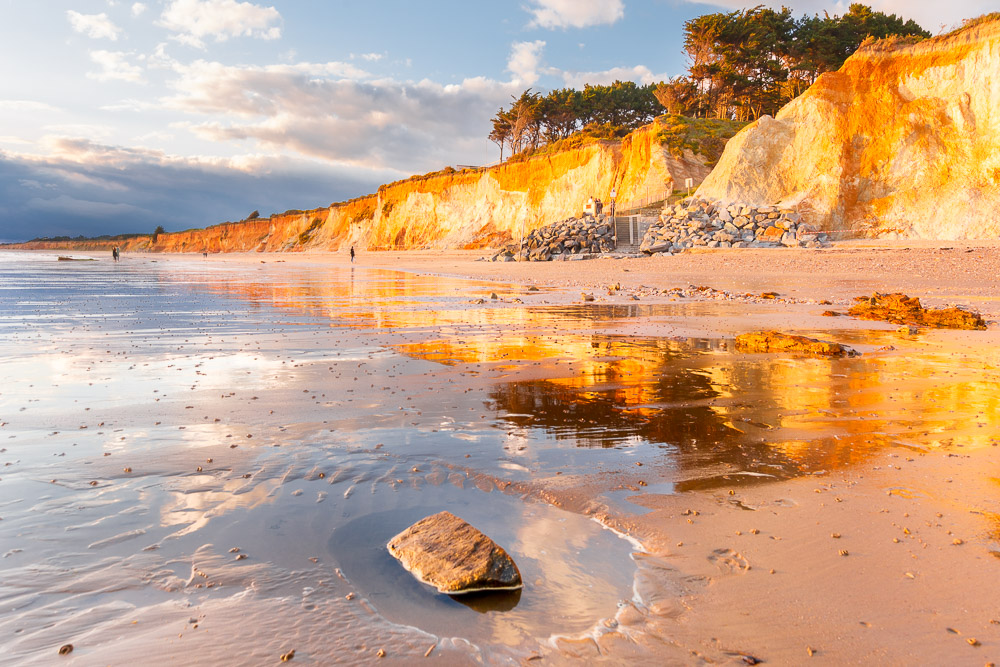
The cliffs of Pénestin and the beach below them are nicknamed “the Gold Mine” (la Mine d’Or). The name comes from the discovery of gold flakes in the sand at the end of the 19th century. However, this very small-scale mining stopped with the First World War. In fact, the cliff contains a lot of tin, which is said to have given the town its name: Pen-Estin.
At sunset, however, the cliffs take on a superb colour reminiscent of gold, which alone would explain this poetic nickname. The natural site has been protected since 1989.


Lucien Mazan Petit-Breton: cycling champion and photographer
Born in Brittany, near Redon, Lucien Mazan grew up in Argentina, where his father had emigrated to set up as a watchmaker.
He loved cycling and wanted to race professionally, but his parents disapproved. So, to hide his career from them, he took the name Petit-Breton in tribute to his home region. He kept it for the rest of his career.
A great champion, he won the Tour de France in 1907 and 1908. He was in fact the first rider ever to win it twice. He rode for Peugeot, and I even found an advertisement showing him alongside Napoleon!
A keen photographer at a time when this was rare, he captured his many travels and his homes. He also photographed life at the front during the First World War.


It was during that conflict that he died, in 1917. He left behind my great-grandmother and three children, wards of the Nation, including my grandfather, born in 1916.

Find out more about the story of Lucien Mazan Petit-Breton.
Featured product

Mount Fuji Sakura Reflection – Limited Edition Fine Art Print
From 190,00 €
DiscoverFeatured posts
- 15 Days in South Korea: My Day-by-Day Itinerary
- In the Footsteps of Lucien Mazan Petit-Breton
- Hildesheim, a UNESCO Town
- Top 10 photo Spots for Cherry Blossom in Japan
See all